
Power outages disrupt operations without warning. When the grid fails, homeowners and commercial facility managers usually face a critical decision: should you rely on a solar generator backup or stick with a conventional diesel generator? While both systems keep essential loads running, their long-term operational impact differs significantly in terms of operating costs, noise levels, maintenance demands, and overall lifetime value.
To choose the right power backup for business or residential needs, you must look beyond the initial purchase price. Evaluating the solar vs diesel cost per unit, long-term fuel expenses, and environmental regulations will clarify which system provides the most dependable ROI.
TABLE OF CONTENT
- How Solar Generator Backup and Diesel Systems Function
- Financial Breakdown: Solar vs Diesel Cost Per Unit & Running Expenses
- Noise, Maintenance, and Equipment Lifespan
- Why Business Power Backup Requires a Hybrid Solar Diesel Setup
- Calculating the True Diesel Generator Running Cost
- When Is a Diesel Generator Still Useful?
- Reliable Energy Solutions with Mahati Enterprises
- Frequently Asked Questions (FAQs)
How Solar Generator Backup and Diesel Systems Function
Understanding how each system operates during a grid failure highlights the fundamental differences in cost and reliability:
Diesel Generators:
Diesel units rely on an internal combustion engine to convert diesel fuel into electrical energy. While they deliver immediate power upon starting, they depend entirely on a continuous supply of fuel and require frequent mechanical upkeep.
Solar Generator Backup Systems:
A modern solar generator backup setup combines rooftop photovoltaic (PV) modules, an inverter, and advanced solar battery storage. Sunlight is converted into electricity during daytime hours and stored in batteries, ensuring clean power is available during grid outages day or night.
Financial Breakdown: Solar vs Diesel Cost Per Unit & Running Expenses
When comparing financial returns, analyzing the diesel generator running cost reveals significant ongoing expenses. Diesel power generation in India typically ranges between ₹27 and ₹33 per kWh (unit) when factoring in fuel consumption, oil changes, and mechanical wear. In scenarios with rising fuel prices, operational costs can reach as high as ₹36–₹40 per unit.
Conversely, a solar generator backup produces electricity at an effective levelized cost of approximately ₹3 to ₹8 per unit over its 25-year lifespan. Because solar power relies on free sunlight, it insulates your facility from unpredictable fuel price surges.
Feature / Metric | Solar Generator Backup | Traditional Diesel Generator |
Average Cost Per Unit | ₹3 – ₹8 per kWh (Levelized over lifetime) | ₹27 – ₹33+ per kWh (Fuel & maintenance) |
Fuel Dependency | None (Powered by free sunlight) | High (Requires ongoing diesel fuel purchase) |
Operational Noise Level | 0 dB (Completely silent operation) | 75 dB – 95 dB (Requires soundproofing) |
Lifespan | Panels: 25 years / Batteries: 10–15 years | Engine: 7–10 years (With heavy overhaul) |
Net Metering Savings | Yes (Exports excess power to the grid) | No (Generates power only during outages) |
Maintenance Burden | Minimal (Periodic cleaning & checks) | High (Oil filters, fuel checks, mechanical servicing) |
Evaluating the solar vs diesel cost per unit clearly shows that while diesel equipment may carry a lower upfront cost, a solar generator backup pays for itself within 3 to 5 years by eliminating recurring fuel expenses.
Noise, Maintenance and Equipment Lifespan
Operational environments matter just as much as financial metrics. Diesel generators produce noise levels between 75 and 95 decibels comparable to heavy highway traffic requiring acoustic enclosures in commercial or residential areas.
In contrast, a solar generator backup operates silently. Furthermore, mechanical engines contain moving parts subject to friction, carbon buildup, and oil degradation, leading to higher maintenance demands. A solar generator backup paired with modern lithium-ion solar battery storage requires minimal upkeep and offers a service lifespan of 10 to 15 years for batteries and 25 years for solar panels.
Why Business Power Backup Requires a Hybrid Solar Diesel Setup
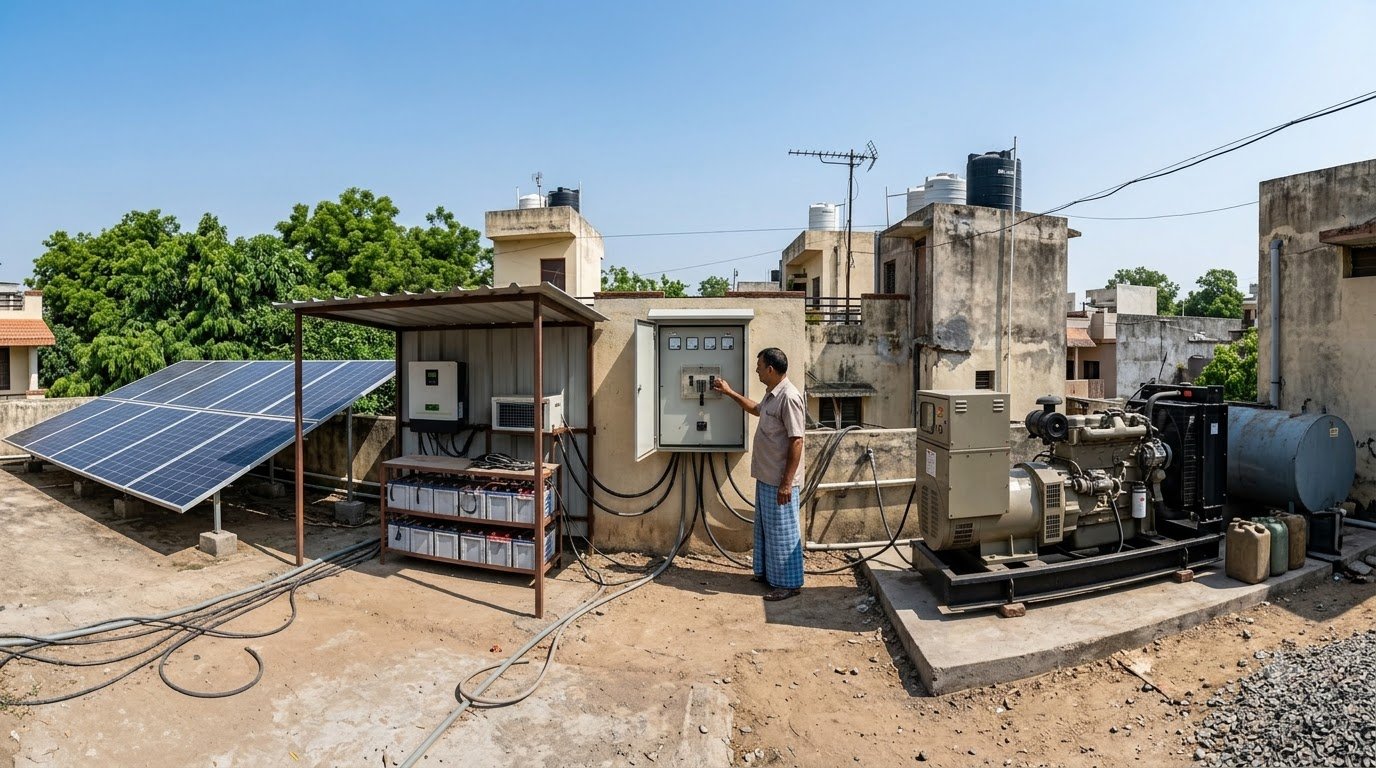
For commercial facilities, manufacturing plants, and hospitals where continuous uptime is essential, combining solar with existing diesel infrastructure offers a highly practical transition strategy.
Implementing a hybrid solar diesel setup allows solar energy to supply the baseline daytime load while charging the solar battery storage bank. If an extended outage occurs during severe weather or prolonged night hours, the intelligent hybrid inverter automatically signals the diesel generator to start using fuel only when battery reserves fall below critical thresholds. A well-engineered hybrid solar diesel setup can reduce overall fuel consumption by up to 80% while ensuring reliable power backup for business operations.
Calculating the True Diesel Generator Running Cost
Many facility owners underestimate the total diesel generator running cost by focusing solely on fuel consumption. A full financial assessment must account for:
- Fuel Storage & Spoilage: Storing large volumes of diesel incurs space costs and risk of fuel degradation over time.
- Frequent Scheduled Servicing: Oil filters, air filters, and coolant checks must occur every 250 to 500 operating hours.
- Carbon Penalties & Compliance: State pollution control boards increasingly restrict diesel generator usage during high-pollution seasons, leading to potential regulatory fines for non-compliant businesses.
Switching to a solar generator backup eliminates these hidden expenses, offering predictable operational budgeting for decades.
When Is a Diesel Generator Still Useful?
Despite the advantages of solar, diesel generators remain relevant in specific scenarios:
- Short-Term Construction Sites: Temporary projects lasting under 3 months where installing rooftop solar is impractical.
- Infrequent Emergency Surge Loads: Facilities needing short bursts of heavy power capacity without long-term daily usage.
However, for permanent commercial properties, multi-story buildings, and residences, relying exclusively on diesel power creates an unnecessary financial drain.
Reliable Energy Solutions with Mahati Enterprises
Choosing the right backup power architecture requires expert engineering and system design. Mahati Enterprises is a leading supplier of renewable energy systems, UPS backup solutions, and battery technologies tailored for residential and commercial applications.
Our specialized energy offerings include:
- Commercial & Industrial Solar Solutions: High-capacity solar installations designed to cut operational overhead for businesses.
- Solar Battery Storage & Hybrid Solar Systems: Intelligent battery storage and hybrid setups that blend grid, solar, and generator power seamlessly.
- Residential Solar Panel Installation: Turnkey rooftop solar setups designed to replace noisy home generators.
- Off-Grid Solar Systems: Standalone solar energy solutions for remote locations lacking reliable grid infrastructure.
- Solar Panel Maintenance & Repairs: Comprehensive AMC contracts, battery health checks, and preventive maintenance services to ensure uninterrupted uptime.
Ready to eliminate high fuel bills with a clean solar generator backup? Contact Mahati Enterprises today for a customized energy audit and site assessment!